
A Woman at the Forefront of Land Justice Reform in Port Loko

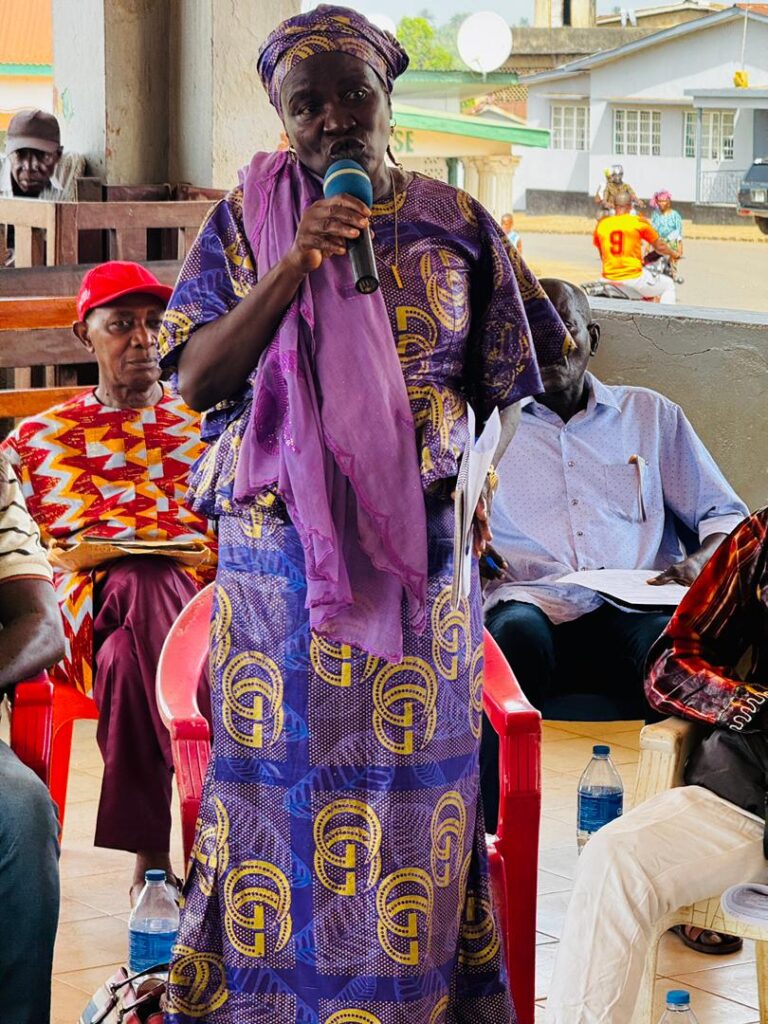
In many rural communities across Port Loko District, customary land disputes often take months, and sometimes years, to resolve. For Madam Alice Mama Mansaray, however, the introduction of the Customary Land Rights Act of 2022 has become an important tool for ensuring quicker and fairer justice within her community.
Madam Alice is currently the only female court chairperson in the whole of Port Loko District, a role traditionally dominated by men. Although the journey has not been easy, she says persistence, fairness, and trust in her judgement have gradually earned her the confidence of the people she serves.
“Being a woman in a male-dominated position in Sierra Leone has been very challenging,” she explained, “But over time, because people trust my judgement and know I stand for justice, many are now bringing their cases to me.” Her appointment as chairperson, she says, was rooted both in community trust and in the growing recognition of women’s leadership.
“I was chosen to serve as chairperson because the Paramount Chief believes in what the law says about women’s empowerment, and the people know I am peaceful and always stand for justice,” she said.
In April 2026, Land for Life organized a training for court chairpersons across Port Loko District. The training was facilitated by the sitting magistrate in Port Loko and focused on strengthening local justice systems, particularly around customary land governance. At the end of the training, all participating chairpersons received copies of the Customary Land Rights Act of 2022 to guide them in handling customary land disputes.
For Madam Alice, the training significantly improved her understanding and application of the law. “The Customary Land Rights Act is the weapon I am using currently to dispense land justice in my community,” she said. Since participating in the training and engaging with both Land for Life and the district magistrate, Madam Alice says she has become more confident in using legal provisions to decide land matters fairly and efficiently.
Recently, she handled a sensitive land dispute involving a female family member who had allegedly been deprived of her land rights by her uncle. “A matter was brought to me where an uncle deprived a female member of her land rights, and I used the Act to solve the matter speedily, which would have taken over a year to determine,” she explained.
Beyond resolving disputes, Madam Alice has also worked to improve the physical condition of the local court. When she assumed office, the court lacked even basic seating arrangements for community members attending proceedings. “When I took over, there were no benches in the court,” she recalled. “I had to move out as a woman to ensure that more benches were constructed.” Her commitment, she says, is ultimately driven by a desire to maintain harmony within the community. “My goal is to ensure that there is peace and quietness in the community,” she said.
Today, Madam Alice Mama Mansaray stands not only as a symbol of women’s leadership in local justice systems, but also as an example of how access to legal knowledge and community support can strengthen fair and inclusive land governance in Sierra Leone