
Malen’s Journey from Land Disputes to Improved Land Governance

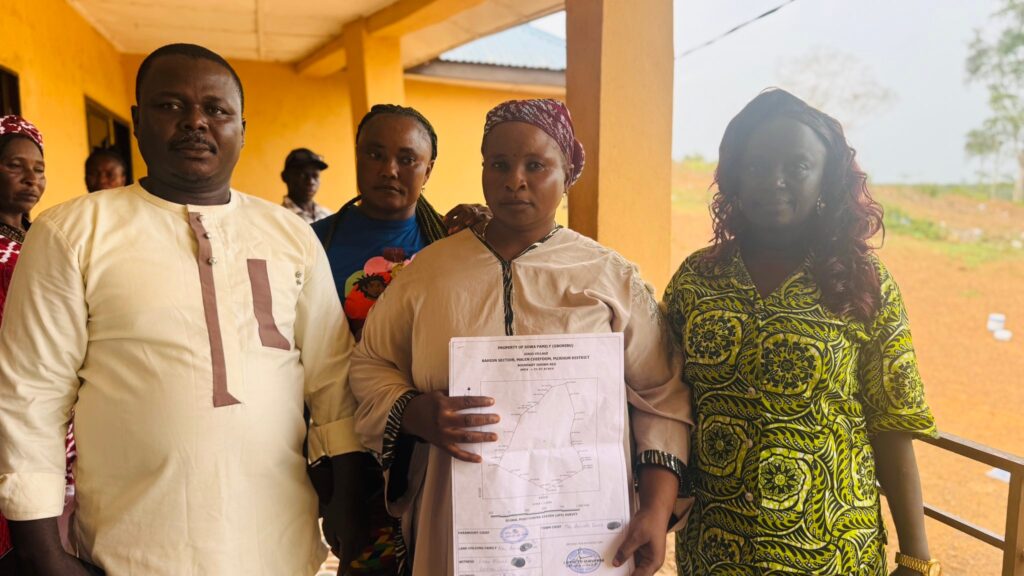
For many years, Malen Chiefdom in Pujehun District was widely associated with one of Sierra Leone’s most intense land-related conflicts involving communities, land-owning families, activists, traditional authorities and Socfin Agricultural Company (SAC), Malen.
At the center of the conflict were longstanding grievances over land ownership, lease agreements, transparency and the payment of lease rent to land-owning families. Many families strongly believed that they were being underpaid for lands leased to the company. However, due to the absence of proper land mapping documentation, most landowners had little or no knowledge of the actual size of their family landholdings. This lack of clarity created deep mistrust between communities and the company, leading to years of tension, protests and disagreements across the chiefdom.
As tensions escalated, civil society organizations began demanding reforms and greater transparency in the management of community lands. The strong and uncompromising advocacy approach adopted by some CSOs created resistance from local authorities and sections of the investment community.
At one point during the height of the conflict, some civil society organizations, including Green Scenery, were reportedly banned from holding community meetings within Malen Chiefdom because of their persistent demands for change and accountability. Activists and human rights defenders faced significant restrictions while attempting to engage affected landowners and communities.
Despite these challenges, advocacy efforts continued. Green Scenery, led by environmental and land rights activist Joseph Rahall, reportedly had to conduct some meetings discreetly and under difficult conditions in order to maintain communication with affected communities and continue raising awareness around land rights and transparency issues in the chiefdom.
In June 2022, Land for Life-Sierra Leone took a major step in advocating for transparency and accountability in Malen Chiefdom by organizing a press conference at the Freetown City Council Building. During the press engagement, the organization called on Socfin Agricultural Company and the late Paramount Chief of Malen Chiefdom to undertake a complete re-mapping of all lands leased in the chiefdom.
Land for Life also demanded that every land-owning family should be provided with an official land mapping document clearly showing the exact size and location of the land leased to the company. In addition, the organization called for lease rent payments to be made directly into the accounts of land-owning families in order to eliminate confusion and improve transparency in the payment process.
Following sustained advocacy and engagement by civil society organizations, rights-based groups, government stakeholders and community actors, significant progress has now been recorded in Malen Chiefdom.
In 2024, a comprehensive re-mapping exercise officially commenced across the chiefdom. The process covered nine out of the ten sections in Malen. At the conclusion of the exercise, findings revealed that the total size of land originally acquired by Socfin Agricultural Company remained largely unchanged.
However, one of the most significant outcomes of the process was the reduction in the number of recognized land-owning families from approximately 6,000 to 443 verified landowners. The re-mapping exercise helped establish clearer records of land ownership and reduced uncertainty surrounding land size and lease entitlements.
For the first time, verified land-owning families received maps identifying the exact parcels of land leased to the company. Community stakeholders say this has contributed significantly to reducing suspicion, misinformation and conflict around lease payments.
The reforms also introduced direct payment of lease rent to land-owning families, helping to improve transparency and accountability in the management of land-related benefits. Other notable improvements include monthly stipend payments to local chiefs, increased support for community agriculture through seed distribution, and the establishment of a community grievance redress committee that now meets monthly to address concerns and disputes.
Today, while some concerns and disagreements still remain, particularly regarding the status of local advocacy groups such as MALOA and Hopanda, many stakeholders acknowledge that Malen Chiefdom has witnessed important progress toward peaceful coexistence and improved land governance.
The transformation in Malen demonstrates how dialogue, transparency, community participation and sustained advocacy can contribute to resolving complex land and investment-related conflicts in Sierra Leone.